




Alright, guys, I'm back and rarin' to go! :) These lectures I have are really paying off, as you'll hopefully see below...
I’ll admit that I haven’t read all the posts, but here're my two cents (not sure what currency, since this is a LOT) about the whole thing:
____________
It's already been established that this is strictly a human factors issue, since N431CA was perfectly airworthy at the time of the crash (well, right before).
Now, pilots are responsible for taking a temporary leave if they are under an exceptionally high amount of stress. I’ve been told that airlines will excuse pilots from their job for a certain amount of time after a traumatic event – ie: the death of a relative – in the interest of having the crew’s full and focused attention on the flight deck.
However, accidents are never the result of one sole mishap. There is always a very long chain of events leading up to accidents like this, and it involves more than just the captain and his or her first officer. The lack of staffing up in the control tower definitely played a major role – aside from them not realizing where the plane was (which, considering the position of the tower and angle of view he had of the two runways, is not difficult to see where a mistake could have been made), they may have just assumed that the crew was familiar with the rearranged taxiways when in fact they were not.
The pilots in here know as well as I do, probably better, in fact, how busy a pilot can be before takeoff. And that’s just in a Cessna or Piper. Imagine the pre-departure checklists and other distractions that a crew has to deal with on the flight deck of a CRJ – with this “link” and the “link” of the taxiway construction and out-of-the-ordinary taxi instructions in mind, it’s not hard to see where the chain could have broken.
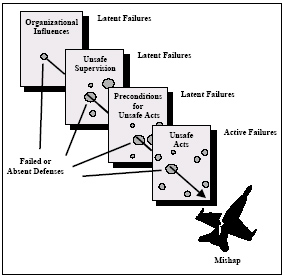
Remembering that stress is the key factor in most, if not all aviation disasters, there’s a very prominent series of events to look at that facilitates a disaster like DL5191. There’s the famous “Swiss Cheese Model” that perfectly illustrates this:
It may look cheesy (hah), but if you ever get the chance to read (or read about) James Reason’s 1990 book “Human Error,” you’ll find that it is widely accepted and has been proven to be true time and time again. Right off the bat, we notice how small the chances of an accident really are; the odds of passing through one hole alone are not very high, and the chances of passing through each and every hole without catching yourself are even more remote. Applying this to the Comair crash, there were obviously several “latent failures” on behalf of many people in the LEX system. This is also one way of analyzing the “links” in the “chain” I mentioned before.
For number 1 – “Organizational Influences” – we can find potential deficiency in the pilot’s training stress associated with meeting strict slot times at ATL, and stress associated with fatigue, among other things.
For number 2 – “Unsafe Supervision” – the obvious lack of ATC supervision is key here, as well as the pilots’ failure to safely carry out necessary procedures and either notice, report, and/or address any discrepancies.
For number 3 – “Preconditions for Unsafe Acts” – there is the (assumed) failure of both crew members to check and crosscheck one another while continually referencing checklists and monitoring aircraft systems. Inadequate CRM and exceptional physical/mental fatigue is also a player here.
For number 4 – “Unsafe Acts” – the decision to take off without obviously and properly verifying the runway led to the death of 47 passengers and 2 crew members.
The breakdown here is clear: starting from the very point the captain and first officer woke up in the morning (or didn’t, to be fair) and through to their arrival at the airport, preflight, pushback, and taxi, they were on a path for destruction. As a result, N431CA went through each hole in the four slices of the “Swiss Cheese Model” and ended up as a burning wreck in some trees a few hundred feet from the end of the runway.
The integrity of this system, or chain, is essential to the safe operation of any airport and aircraft.
See this link for some more reading: http://www.coloradofirecamp.com/swis...troduction.htm
This whole notion of stress was actually the driving force behind the Tenerife crash back in the 1970s which, as we all know, is the deadliest aviation disaster in history. In short, the KLM captain – the most highly regarded crew member in the airline, mind you – was more concerned with resuming his flight to the Netherlands and not exceeding crew-time than he was with the safe operation of his aircraft. Stress got the better of him and he jumped to conclusions when he heard the controller say “standby for take off” while the PanAm 747 was backtracking up the same runway – in fact, someone apparently cued the mic during the controller’s transmission, so all the KLM crew heard was “take off.” Impatient and preoccupied, the captain took this for clearance and advanced the throttles to the point where they collided with the PanAm ship and killed 583 people.
Interestingly enough, since then, the phrase “standby for take off” has been completely replaced by “hold short” and “position and hold.” In fact, the only time you will (or should) hear “take off” is when receiving clearance.
With regards to the compass heading/runway number conflict…
In this photo, you can see the two taxiways in question: the one going straight along the bottom, A7, was closed, and the CRJ was supposed to taxi across runway 26 to where the business jet is.
1) The crew obviously made the first left, instead of the second left they were supposed to. That’s the only way to mistakenly line up with 26 instead of 22. Their position on either runway is such that in BOTH cases, they would have been in front of the runway numbers. The only way for them to know for sure which runway they were on would be to check their compass heading.
2) Pilots here: How many times have you misread your heading? The directional gyro and compass are visual cues the pilot uses to approximate their heading with a quick glance. Few, if any, sit there and count each 2-degree tick on the arc. Sure, 40-degrees is hard to miss on the navigation display in a glass cockpit, but it’s entirely within the realm of possibility that they either misread or didn’t even check their heading. We’ll never know for sure.
Looking back, there’s one fundamental difference between the crew of 5191 and all other crews today: they didn’t have a fatal crash to remind them of heading-checks before pushing the throttles forward.
Stepping on (or off, I’m not really sure!) my soapbox for a minute, I was thinking of a way this could have possibly been prevented. After using a sophisticated 737 model for FS designed by PMDG (http://www.precisionmanuals.com), it becomes obvious that an alarm sounds if the throttles are advanced without being in proper takeoff configuration (I imagine this is true on most, if not all other modern aircraft). The information that trips this alarm comes from the FMC…and the departure runway has to be entered into the FMC as part of the flight plan. My thought is this: have the runway heading (+/-1.5 degrees) included in this packet of “critical take off configuration information” and have the alarm sound if the current runway heading doesn’t match the FMC when the throttles are pushed forward.
I spoke with an experienced assistant professor in the aviation department at my school last week, and he told me about how he had once heard of a pilot who, after some 30 years with an airline, never once encountered an accident or incident. He also told me about another pilot who, after 30 years, had hundreds of events (but none fatal). Which one would you rather fly with? Well, this professor said he would rather go with the former…within 30 years, it’s impossible for him to never have had something out-of-the-ordinary occur. The difference, though, between him and the second pilot is that he was able to recognize and deal with a small discrepancy before it snowballed into a big problem. Yes, we learn the hard way, and yes, “the rule books are written in blood”, but it’s impossible for us – or even the NTSB – to blame any one person or thing. We’ll surely see a slew of new regulations and technology as a result of this crash.
A pilot friend recently said:
I’m sure his suggestion will become a regulation in some way, shape, or form. However, I wouldn’t be so quick to assume that the on-going training and procedures at Delta (or Comair, whoever) are lacking…clearly, “human factors” is the likely umbrella-explanation for all this, and it’s quite an area of study to be reckoned with. If the problem lies in the most basic of training, we’d be seeing crashes like this every week.When things have changed aroud you (construction and upgrades) there is no harm in calling for some confirmation and waiting for acknowledgement. If they both misread or (both) never even checked then the on-going training and procedures are lacking.
Once you introduce the factors I discuss above, flight operations take on a whole new face. Training and logical assessment go out the window, leaving us with a very unpredictable crew. Fatigue as a result of an early-morning flight following a late-night flight is similar to the state-of-mind a pilot, for instance, may be in when a relative is ill. Only difference is that there’s no way for the airline to detect this danger in time and compensate for it. Actually, the airline has no interest in dealing with this on such short notice since it costs money and time to change crews. An unfortunate truth, but a truth nonetheless.
This pilot-friend also said:
Absolutely…and this is why there are over 6,000 uneventful flights in the sky above the United States at any given moment, any given day. The last fatal crash in commercial aviation was almost 5 years ago, but that was in a league of it’s own. Point is simply that we learn the hard way. The automated, fail-safe alarm systems in every nook and cranny of a modern jet these days are not in lieu of a diligent and level-headed crew – no way, no how – but they are a necessity in situations like this, where the aircraft is controlled by a crew compromised by one thing or another.We're skilled professionals whose job it is to follow those procedures for the safe conduct of our flight. There are 2 of us (or sometimes more) so things are Checked and Cross-Checked. Two heads are better than one, if they agree. Each of them must be as diligent as the other and those Cross Checks ensure that.
If humans can’t plug the holes in the Swiss cheese, then machines will have to do it for them until a better solution is found.
Over ‘n out,
Brian


 Reply With Quote


 Originally Posted by futterman



Bookmarks