It almost seems like airplanes are playing a zero-sum game with the Hudson here in New York. From almost the same point on the river where we saw 155 US Airways passengers walk away from a ditched A320, news now comes of a fatal mid-air collision between two sight-seeing flights.
A Eurocopter EC130 has collided with a Piper PA-32 Cherokee Six near the 30th Street Heliport on the West Side of Manhattan, killing 9 people, according to the latest reports. The helicopter is understood to have been carrying 6 passengers for Liberty Helicopter Sightseeing Tours.
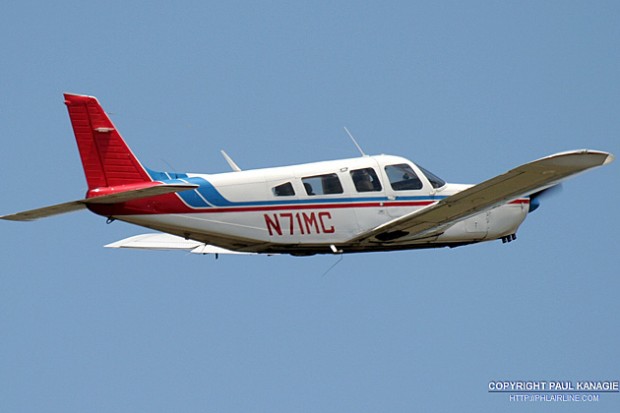
Radar contact was lost with the fixed wing aircraft involved after it departed Teterboro Airport (TEB) at 11:54am. The Cherokee Six, registered N71MC, was carrying three passengers.
This incident comes just over four years after two helicopters ended up in the East River four days apart, fortunately with no fatalities. And unlike January’s “Miracle on the Hudson”, search and rescue boats appear to have set up a perimeter around the crash site so other vessels on the waterway do not interfere with the ongoing efforts though an eyewitness does report Circle Line tours as having been the first to respond to the crash. With 2-3 feet of visibility in the water, emergency divers are making slow progress of locating wreckage.
The mid-air collision (which would fall under the category of a “near-miss”, for the record) is said to have torn a wing from the Cherokee and caused the two aircraft to spin straight down into the water.
For area pilots, the Hudson River Corridor is a popular, albeit challenging section of airspace over the waterway that requires constant vigilance to “see-and-avoid” other aircraft that are operating between 1,100 and 1,500 feet of the water’s surface. While the rules governing VFR (Visual Flight Rules) flying are very cut-and-dry regarding aircraft and obstacle separation requirements, we can already tease some basic facts from what happened to see what may have contributed to the crash:
- Piper aircraft, including the PA-32, are low-wing aircraft, which can make it difficult to scan for traffic flying below.
- There’s a big distraction out your window: the skyline.
This is now a recovery effort, according to NYC officials. Mayor Bloomberg, who is actually a pilot with helicopter experience (and therefore a little more credible than certain other politicians in the area), has called the crash “not likely survivable” and smartly reminded everybody that, until the NTSB has completed its investigation, “nothing is a fact”.
If it seems strange to you that this mid-air collision happened (or that any crash can happen) on a clear day with more visibility than you can shake a stick at, hang on to your chair. What happened today was textbook – VFR, daytime, weekend, below 1,000 feet. The University of Illinois put out a great paper on MAC that pulled NTSB statistics to show that this is true. In a nutshell:
The NTSB in its report on the 1956 MAC over the Grand Canyon probably sums up this finding for almost all the MAC: “the pilots did not see each other in time to avoid a collision. Evidence suggest that it resulted from any one or a combination of the following factors: intervening clouds, visual limitations due to cockpit visibility, preoccupation with normal cockpit duties, preoccupation with matters unrelated to cockpit dutues…(and) physiological limits to human vision reducing the time and opportunity to see and avoid the other aircraft” (Air Safety Foundation, 2001).
The 1956 example they’re referring to was a collision between a United DC-7 and a TWA Constellation over the Grand Canyon that hastened the development and implementation of radar and other ATC services. Another mid-air collision involving a PSA 727 and Cessna 172 over Los Angeles in 1978 changed aircraft separation requirements and expanded controlled airspace.
It’ll be interesting to see what changes today’s mid-air will bring, though I’m right there with Miles O’Brien in hoping that it won’t be a knee-jerk permanent closure.