


I know that sometimes 757s will be given a heavy callsign on the radio. Why is that?
I know it's the case for ATA and also for North American. Is it becuase they do it for airlines that I like or another reason? ;)




I know that sometimes 757s will be given a heavy callsign on the radio. Why is that?
I know it's the case for ATA and also for North American. Is it becuase they do it for airlines that I like or another reason? ;)
Email me anytime at [email protected].


I always thought it was the weight of the plane, but the 757 alway is a heavy due to the extra spacing that is needed behind it
Overheard on JFK TOWER - S Turns are fine, U-Turns are bad....
A heavy is an aircraft capable of takeoff with 255,000 pounds or more. Even if they don't weigh that much at takeoff, they still are considered heavies. The 757-200 is not a heavy while the 300 series is.
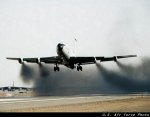
Found this on-line
From FAA Order 7110.65R - Air Traffic Control (Appendix A)
Also, they have a chart which lists the 752 as "Large" and the 753 as "Heavy""AIRCRAFT CLASSES- For the purposes of Wake Turbulence Separation Minima, ATC classifies aircraft as Heavy, Large, and Small as follows:
a. Heavy- Aircraft capable of takeoff weights of more than 255,000 pounds whether or not they are operating at this weight during a particular phase of flight.
b. Large- Aircraft of more than 41,000 pounds, maximum certificated takeoff weight, up to 255,000 pounds.
c. Small- Aircraft of 41,000 pounds or less maximum certificated takeoff weight."
While it doesn't refer to it directly in this paragraph, most places I've seen this referenced also include:
The exception to this is the 757- in the US only, it is considered a "heavy" due to the need for additional separation from other aircraft and its unique wake vorticies.
KC-135 - Passing gas & taking names!
http://www.jetphotos.net/showphotos.php?userid=15086
http://moose135.smugmug.com
This makes sense. According to my math, an average 757-200 at its absolute heaviest possible weight tips the scales at ....literally....254,900 pounds.Originally Posted by moose135
Sounds like the 255,000 mark that they made was specific to keep the 757 out of the 'heavy' arena, with the exception of wake turbulence requirements.
Email me anytime at [email protected].
Moose you are correct in that its treated like a heavy b/c of its wake, but it is not called a heavy in the callsign.
I've seen otherwise. The reason I asked is because last week I heard a North American 757-200 referred to as a heavy at two different airports during an empty ferry flight.
Email me anytime at [email protected].
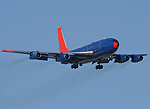
Some airports do opt to refer to a 757 as "heavy" MDW being one of those. It is the largest aircraft to fly into MDW as well. At ORD occationally the Mexicana 757-200s would refer to themselves has "heavy".
Senga

Hmm, I thought only the 753 is a heavy. I guess I am wrong!
nwa FOREVER!
Some 752's do have added MTOW. AmTran and No Am both do as Phil mentioned. Senga, I've never heard of particular facility calling 752's (that dont have that added weight) heavies. Everyone working traffic knows who is a heavy and who is not, all stated in the .65 *the doc that moose posted*
Doesn't matter if it's empty or not, a heavy is a heavy, based on max takeoff weight. As I noted, 757s are typically handled as heavies due to wing vortices, so the controller may have called them "Heavy" to denote this.
KC-135 - Passing gas & taking names!
http://www.jetphotos.net/showphotos.php?userid=15086
http://moose135.smugmug.com
Interesting topic. I always was under the impression that the -300 was a heavy and a -200 was not. Everytime I've flown on UA's 752s and tuned into channel 9, we've never been referred to as "heavy". About a week and a half ago, we landed behind a UA777 and a BA777, both were called heavy, but we were not. I think we had a 319 or 320 land behind us, and the controller advised him that we were a 757 and to caution for wake turbulence.
What is it about the 757 that causes wake turbulence to be so different from any other heavy? Any what is a pilot--given a "caution wake turbulence"--supposed to do? Ask the tower if he can slow down? (not likely) Steer out of the way? Brace?
I'm learning to fly, around the clouds. But what goes up must come down. - Tom Petty
It's handy information, especially if you're flying an aircraft that's lighter or smaller than the one generating wake turbulence in front of you. Since wake sinks, the typical evasive maneuver (from a GA perspective) would be to stay slightly above the glidepath of the culprit. Or, if you're in line to take off, just wait two minutes for it to dissipate and try to get in the air before the generating aircraft rotated.
It's also important to note that wake turbulence is produced as soon as the wings start producing lift, which means that it's an issue for most of the takeoff roll and not just when the aircraft becomes airborne.
There's a whole 'nother big ball of wax that deals with drifting vortices, light-quartering tailwinds, etc., but that's for another time.
And not to put you on the spot, Moose, but do you have any exhilerating military experiences with wake turbulence from your "Top Gun" days? ;)
Brian
"My wife is an air traffic controller. I married her because I've always wanted to screw the FAA." - B. Wulle
Never really remember any serious wake turbulence encounters, well, except for some of the bouncing around you got as number 2 or 3 (or 4!) on a MITO. That's minimum interval take off - 12 seconds spacing between tankers - when you aren't the lead dog on a wet MITO, the view never changes :D
A bigger factor we faced in the tanker was the bow wave effect of large receivers (C-5, KC-10). Think of standing along side the highway when a large truck goes by at speed - you get a blast of air, that's the "bow wave" of air being pushed aside by the truck. Aircraft do the same thing, and when a large receiver pulled up under us (and the nose of the receiver would be under the horizontal stab of the tanker) the bow wave would push the tail up. If you don't keep up with the trim, you get a very nose-down push, not the kind of thing you want with a *very* large aircraft pulling up under you :shock:
Usually, we would fly tanker A/R with the autopilot on, and for most receivers the autopilot would compensate, but for the big guys, especially if they closed quickly, you needed to run some trim in manually to keep up.
Between bow wave effects off the receiver, and downwash effects off the tanker wing, is it any wonder the air refueling manual has this to say:

KC-135 - Passing gas & taking names!
http://www.jetphotos.net/showphotos.php?userid=15086
http://moose135.smugmug.com
 Posting Permissions

 Reply With Quote
Bookmarks